
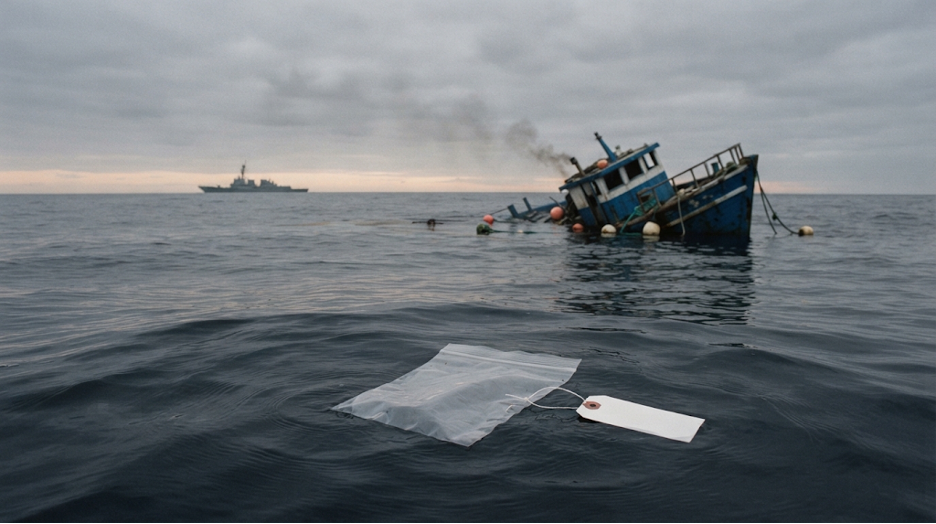
Between August 28 and September 16, U.S. forces boarded eight Ecuadorian fishing boats in the eastern Pacific, took 160 crew members off, and sank the boats. Human Rights Watch documented the operations and the Washington Post reconstructed them from Ecuador’s main Pacific fishing port. Seven weeks on, 32 of the crew have been acquitted, 56 released without charge, 14 never brought before an Ecuadorian judge, and 58 released under restrictions while their cases move forward. None has been convicted. Crew from a third boat, the Don Rufo, went to trial on October 20, and the judge is due to rule on October 29. The largest group, 46 crew, is due back in court on October 23 after two prosecution witnesses failed to appear at the first hearing.
Earlier we looked at strikes that left no one alive to contest the government’s account. Off Ecuador, the crews survived. The government’s account went to court, and it has not held up.
What changed off Ecuador
The strikes that began in the Caribbean and eastern Pacific in September 2025 destroyed boats with their crews aboard. Air & Space Forces Magazine counts at least 71 of them and 215 dead. The Ecuador operations work differently. Marines and sailors from the amphibious ship USS San Antonio board a larger fishing vessel, detain the crew, and then destroy the boat. U.S. Southern Command describes these vesselsas floating fuel stations that resupply drug boats for Los Choneros, an Ecuadorian criminal group.
The change came from Ecuador. An Ecuadorian intelligence official told the Post that Ecuador agreed to join the operations only if boats were not destroyed with their crews still aboard. Secretary of State Marco Rubio drew the line himself. Unilateral strikes happen in international waters, and joint operations inside a partner’s waters follow that partner’s laws.
Outside those arrangements the old method continues. An October 4 strike in the Caribbean killed all four people aboard.
What the courts saw
The crews’ cases reached Ecuadorian courts with almost nothing in the file. Human Rights Watch reviewed two Ecuadorian Judicial Police reports covering 74 detainees. The only evidence listed was seafarer registration cards and identity documents. There were no drugs, no fuel, and no cargo.
Evidence takes other forms, and those were thin too. For the nine men taken off the Conquista II, the Post found that police and prosecutors offered no photographs of extra fuel tanks, no text messages, and no intelligence tying them to traffickers. The only video I could find in the public record is Southern Command’s own footage of the boat being blown up.
On September 28 a court heard the case against 34 crew members from two boats. Defense lawyers told Human Rights Watch the prosecution offered a forensic report on phones that held family photos, the seafarer cards, and a police report. The defense lawyer, Juan Alvia, later said the file also held statements from Ecuadorian military personnel and sailors, and no report from the U.S. government implicating the men in anything illegal. Defense lawyers said Ecuadorian police and Navy officials acknowledged in court that U.S. forces had provided no evidence of a crime and that Ecuador had collected none. On October 7 the judge acquitted 32 of them.
Crew members also told Human Rights Watch that U.S. forces collected their biometric data and questioned some of them aboard the San Antonio, and that some were beaten, threatened, and made to sign an electronic document they were not allowed to read. Those are the crews’ accounts. Whatever U.S. forces recorded in those interviews, nothing in the court reporting shows it reaching an Ecuadorian prosecutor. Neither government answered the group’s request for comment.
Why the evidence never arrived
The Post could not establish why the United States has given Ecuador no evidence, or whether any exists. It raised two possibilities, protecting ongoing investigations and Washington’s distrust of an Ecuadorian judiciary badly compromised by narco-corruption. Two Ecuadorian intelligence officials gave a simpler answer. They said the administration told Ecuador its main goal was deterrence, and one summed up the American position as “I’ll take that boat, and that’s it.”
I think the reason is more ordinary, and I have seen it before. Evidence in a criminal case is only as good as the witness who can stand behind it. A conviction in an Ecuadorian court would need the Marine or sailor who boarded the boat to say under oath what was found, how it was handled, and who held it afterward, and then to face cross-examination. U.S. military personnel do not appear in a host nation’s criminal trials as a matter of course, and without them the chain of custody runs thin. I have watched this happen elsewhere, and I have watched U.S. officers wonder why the courts kept releasing the people they detained.
I spent six years funding the other end of this problem in Somalia. My portfolio in the State Department’s Bureau of Counterterrorism paid for Mogadishu’s Joint Investigative Team and its Forensic Science Lab, because a terrorism case that reaches a courtroom without evidence ends in a release. The work is unglamorous. Photograph and video record the vessel and its tanks before anyone touches them. Measure the fuel and take samples. Seize the phones and pull the GPS track. Have the boarding officer write a statement while the details are fresh. Log every item seized from the deck into the evidence room, documenting the chain of custody. None of that requires keeping a boat afloat for more than a few hours.
Ecuadorian officials told the Post these cases are hard to prove without surplus fuel, extra motors, improper fishing papers, or phone records. That list is what a boarding team would have collected. Sinking the boat put all of it beyond the reach of a prosecutor.
Deterrence has its own test. Ecuadorian officials told the Post that seizures at sea seemed to fall after the first boardings. On October 3, the Ecuadorian Navy captured a go-fast boat off the coast carrying about 55 bundles of suspected drugs.
That seizure also shows what Ecuador can do on its own. With no U.S. role reported, the Navy stopped the boat and found about 5,000 pounds of suspected drugs. The three Ecuadorians aboard were handed to the authorities to be investigated for large-scale trafficking, an offense that carries 22 to 26 years in prison. Ecuador sank that boat too, citing the hazard to shipping. The difference is that Ecuadorian sailors made the seizure, and Ecuadorian sailors can testify to it.
The same wall on land
Gen. Francis L. Donovan, who heads Southern Command, has indicated the United States will move from strikes at sea to targets on land. Ecuador’s defense minister confirmed in early October that two MQ-9 Reaper drones moved from Africa were already flying in Ecuadorian airspace, and a 600-soldier battalion from the 10th Mountain Division began deploying to Panama on October 15 to train partner forces in Colombia and Honduras.
Land operations will produce detainees and seized material, and both will go to the same courts. In March, U.S. forces helped Ecuador’s military strike properties near the Colombian border, and the September piece here covered the dairy farm found among the targets. A drone can find a lab or a fuel cache. A conviction still depends on someone who collected what was there and will say so in court.
A model already exists
The United States has worked with Ecuador at sea under law enforcement rules before. The two countries’ agreement on counter illicit maritime activity operations entered into force on February 23, 2024, and it lets an Ecuadorian officer ride aboard a U.S. Coast Guard cutter. On a 40-day eastern Pacific patrol in late 2024, the cutter Venturous carried an Ecuadorian officer under that program, and its boardings produced six suspects for prosecution in U.S. federal court.
Neither the Post nor Human Rights Watch mentions a Coast Guard boarding team or an Ecuadorian officer on the Ecuador interdictions. Marines and sailors did the work. Fixing that needs no new authority. An Ecuadorian officer on the boarding team could photograph the vessel, take the samples, keep the custody log, and testify to all of it in an Ecuadorian court, with no American on the witness stand. Behind that, it needs an evidence handover protocol between Southern Command and Ecuadorian prosecutors, and State Department law enforcement assistance for Ecuador’s judicial police and prosecutors. Congress can ask Southern Command for conviction counts alongside strike counts.
What to watch
My forecast is that the Don Rufo ruling on October 29 and the case of the 46 end the way the October 7 trial did, in acquittal or release. When land operations in Ecuador or Colombia begin producing detainees, those cases are likely to fail in court for the same reason.
Two developments would prove that wrong. One is an Ecuadorian conviction in one of these cases, which would mean evidence reached the court with a witness willing to stand behind it. The other is Southern Command putting Coast Guard teams or Ecuadorian officers on the boardings under the 2024 agreement. Either would mean the campaign has started building cases instead of only sinking boats.
The CT Conundrum is a national security and counterterrorism publication. If you found this analysis valuable, please consider sharing it or subscribing.
Jim Loucks is a former U.S. counterterrorism advisor and career law enforcement professional. He writes on counterterrorism and national security issues at The CT Conundrum on Substack at thectconundrum.substack.com.
Strong piece. In narcotics cases I ran, the hardest files were the ones where the intelligence that justified the stop could never enter the courtroom without burning a source. So I wonder whether part of what you describe is a choice: Washington may simply value protecting the source picture over winning in Ecuadorian court. If so, the fix you propose works only once someone decides convictions are a goal at all.
Jim, this analysis highlights a fundamental principle that is often overlooked in security operations: tactical success and legal success are not the same, and neither automatically produces a lasting strategic outcome.
From my experience in Afghanistan’s security environment, an operation must be assessed not only by what it disrupts or destroys, but also by the evidence it produces, the legitimacy it preserves, and the institutions capable of sustaining its results. When detention, intelligence collection, evidence preservation, and prosecution are treated as separate responsibilities rather than parts of one operational system, the gap between force and accountability can become a serious strategic weakness.
The destruction of a suspected vessel may eliminate a logistical asset, but if the operation also destroys potentially exculpatory or incriminating evidence, it can undermine the very case needed to establish responsibility. Allegations must be tested, evidence must be traceable, and the people conducting an operation must be able to account for their actions before a competent court. Otherwise, deterrence risks becoming a substitute for proof rather than an outcome supported by law.
There is a wider lesson here for counterterrorism and counterinsurgency as well. Security forces may achieve immediate operational effects while weakening public confidence, partner institutions, or the legal foundations of subsequent action. Those costs may not appear in an operational report, but they can shape the long-term outcome.
The real measure of an effective security operation is therefore not simply whether a target is removed. It is whether the operation produces a verifiable result that can withstand independent scrutiny, support lawful prosecution where warranted, and strengthen rather than erode the legitimacy of the wider security effort.
Force can disrupt a network. Evidence establishes responsibility. Lawful accountability is what makes the result defensible and sustainable.